1882 ward brake & coupler monongahela pa
A "Power Brake, Not an Automatic Brake.
Inventor W. H. Ward
- W. H. Ward, Managing Director.
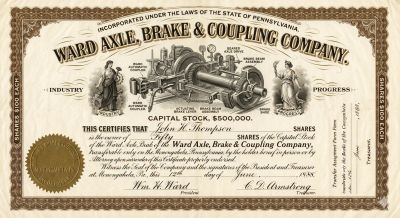
- The Ward Axle, Brake & Coupling Company,
- Main manufacturing works were built in Monongahela City, PA, with a high-profile corporate syndicate office located at 87 Diamond Street, Pittsburgh, PA
- . Important Contract. Perhaps the heaviest contract ever made in this valley was consummated on Saturday, March 1st, between the Ward Axle Brake &; Coupling Company, and a Pittsburg syndicate of railway men and capitalists, for the equipment and adoption of the Ward Brake and Coupler,
- For use on nineteen freight and passenger railways of the United States. To fill these orders will require from three to five years, and aggregating over a million dollars.
- Syndicate" Era: The "Pittsburg syndicate of railway men and capitalists" refers to the powerful group of Gilded Age industrial investors who funded regional infrastructure. Securing their backing was the 19th-century equivalent of winning massive venture capital.
- Scale of the Contract: A one-million-dollar contract in the 1880s is equivalent to roughly $30–$35 million today.
- For a local manufacturing outfit along the Monongahela Valley, this was an astronomical sum that guaranteed massive regional job growth and factory expansion.
- Mass Adoption: Equipping nineteen railways across the United States shows that William H. Ward's design wasn't just a localized experiment; it was actively competing with major industry standards like the Westinghouse Air Brake.
- Active stock offerings, trade journal features, and syndicate contracts heavily clustered between 1883 and 1886
- By the time the Railroad Safety Appliance Act of 1893 legally mandated automatic systems nationwide, the Ward Company had dissolved, leaving its beautifully engraved stock certificates to become rare historical collectibles
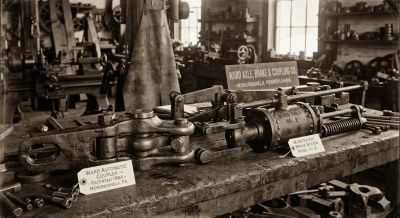
ward brake & coupler
Monongahela Pa
The Ward Axle, Brake & Coupling Company was an ambitious, short-lived 1880s railroad technology startup based out of Monongahela City and Pittsburgh, Pennsylvania.
Managed by inventor W. H. Ward, the company sought to solve the two deadliest mechanical crises facing late-19th-century rail travel:
inefficient manual hand-brakes and lethal link-and-pin car couplers.
A "Power Brake," Not an Automatic Brake
"the Ward Brake is not an automatic, but a power brake."
- In 1880s railroad terminology, an automatic brake (like the Westinghouse air brake) meant that if a train car accidentally detached, the loss of pressure would automatically trip and lock the brakes on its own.
- A power brake meant that the braking mechanism relied on a central force generated or controlled directly by the locomotive engineer to apply stopping power simultaneously across the entire train, rather than relying on brakemen to run across car roofs to spin manual wheels.
Complete Engineer Control (Forward & Back)
The brake was entirely under the control of the
engineer (or trainmen) at will for either forward or back,
the same as by the best of air or known vacuum brakes."
- This is a crucial distinction from a standard momentum-only "buffer brake." A pure buffer brake only applies when the train is moving forward and the locomotive slows down (compressing the cars).
- Ward’s design included a mechanism—likely a continuous cable, rod, or steam-actuated chain loop under the train—that allowed the engineer to actively engage or disengage the brakes from the cab, regardless of whether the train was rolling forward or reversing.
High Efficiency for Freight Use Mr. S.W. Haines,
the Superintendent of Motive Power and Rolling Stock,
gave it a stellar review: "for a freight brake with wheel shoes
he could recommend it as the best he knew of."
- Freight trains of the 1880s were notoriously difficult to stop because they carried immense weight (like Monongahela coal) but lacked the expensive, early pneumatic piping found on luxury passenger trains.
- The fact that a Superintendent of Motive Power officially recommended it to other railroad officials proves that Ward's mechanical power brake successfully delivered massive stopping force ("a power brake of very great power") without the immense expense and maintenance liabilities of early air hoses.
- The Axle/Track Brake: Traditional brakes pressed iron shoes directly onto spinning wheel treads, causing wheels to slide, lock up, and grind dangerous "flat spots" into the metal.
- The Ward Brake was a "wide departure" that applied friction directly to the top or sides of the stationary rail using an extended shoe, or transferred stopping force inward toward the rotating axle assembly.
- The Automatic Coupler: It integrated a mechanical, self-locking mechanism that coupled train cars automatically upon impact. This eliminated the need for brakemen to step between moving cars to manually drop a coupling pin.
The Million-Dollar Contract: On March 1st (circa 1885), the
company signed a massive $1,000,000 syndicate deal
with wealthy Pittsburgh capitalists and railroad executives.
- The contract called for the adoption of Ward equipment across 19 American freight and passenger railroads, establishing a projected three-to-five-year manufacturing backlog.
- Aggressive Stock Offerings: Capitalizing on the contract, the company extensively marketed shared stock to citizens in Monongahela City and the surrounding valley, promising astronomical investment returns.
- Media Attention: Major trade journals like the American Journal of Railway Appliances offered to illustrate and feature the Ward system free of charge due to intense nationwide demand for new railway safety appliances.
- .The Test Site: The Pittsburg and Western Railroad (P&W) was a crucial regional carrier that operated narrow and standard-gauge lines north and west of Pittsburgh. Using this line for testing was strategic; its hilly, rugged terrain provided the ultimate proving ground for a train-stopping mechanism.
- The "Yankeeland" Threat: The mention of "New England parties" attempting to lure Ward away reflects the intense inter-regional competition of the era. New England was a dominant manufacturing hub, but the Monongahela Valley was fighting fiercely to retain its heavy industrial assets. The community pressure to keep the shops locally based underscores how valuable manufacturing jobs were to Monongahela's growth.
The Moving Halt Engine moving at a "lively speed" with
full steam actively left on. The brake completely overpowered
the engine's propulsion, bringing the train to a smooth stop without
shutting off the boiler steam.
The Grade LockTrain positioned on a downward slope where gravity
alone would cause a rollout.The brake was locked down, and the
engineer opened the throttle completely.
The engine could not move a single inch against the brake’s
holding power
- "It is better" (Performance): It stopped trains without the violent, "unpleasant jarring" that flat-spotted iron wheels or snapped early automatic couplings.
- "It is simpler" (Maintenance): Railroads hated complex systems because track grime, ice, and coal dust routinely jammed intricate machinery.
- "It is cheaper" (Cost): The massive scale of American rail networks meant that even a superior brake would be rejected if it cost too much per car to outfit a fleet.
haywood gregg removable wheel bearing 1903 Monongahela pa
Invention of a New Mine Car Wheel Bearing May Revolutionize the Manufacture of Wheels and Pulleys
Harry Hayward, manager for the Reliance Foundry Company Monongahela Pa.
The inventor of a new Mine car car wheel which promises to revolutionize the manufacture of that branch of the pit car industry.
While the principle is applicable to all wheels and pulleys, the most promising field for its practical development is in the coal car, where the constant friction in the bearings makes the renewal of the car wheel a frequent occurrence and a heavy expense.
The patents on the wheel are owned jointly by Harry Hayward and David Gregg. of Monongahela
The peculiarity of the new wheel is due to the method used in the construction of the bearings. It is as in such a manner that when the bearings become worn they can be taken out and replaced by new ones and the wheel will be again as good as new at about one-fourth the original cost.
Special arrangements for lubricating the wheel are also provided for and this feature will greatly reduce the wear on the bearings. The new style wheel can be produced at the same cost as the old style ones hence sold at the same price.
The saving is in the cost of renewal which has to be frequently made, and with the new wheel is only one-fourth what it now 's with the old style ones in use.
The first shipment of the new product went forward yesterday, an experimental order of twenty wheels being sent to the Humphries Coke works at Vance's Mills It is confidently believed that in a short time the wheel will be in general use in mines and that the old style ones will be regarded as too expensive for economical use.
Track shives are also made in the same manner. It will be even more economical in this branch than in the wheels themselves, as the shives can be cast of much harder metal and therefor wear much longer.

Removable wheel bearing 1903
1st Removable Wheel Bearing
- Manufactured in Monongahela Pa
- PIT & COAL CAR WHEELS, designed to withstand constant bearing friction and lower maintenance costs.
- Solid fixed
- Application: Adaptable to general wheels and pulleys, but focused on heavy-duty industrial rail and coal car usage
- Patent Number: US 762,713 A
- Invention Title: Car-Wheel
- Filing Date: September 19, 1903
- Issue Date: June 14, 1904
- Inventors & Joint Owners: Harry Hayward & David Gregg
The 1904 Haywood-Gregg patented design introduced a removable wheel hub and integrated, sealed bearing assembly, whereas earlier industrial mine car wheels relied on a primitive, single-piece cast iron construction
The design utilized a closed-hub system with a sealed end cap. This served a dual purpose: it acted as an internal oil/grease reservoir that could lubricate the wheel automatically for weeks, while completely sealing out damaging coal dust and grit.
Mine car Wheels were replaced with new ones and the worn wheels were scrapped before this invention
